Kathmandu to Lukla Helicopter: Your Direct Flight to Everest
The Strategic Shortcut to Everest
You didn’t spend all those months dreaming of Everest, poring over gear lists, breaking in your boots, staring at maps, to kick things off with a traffic jam.
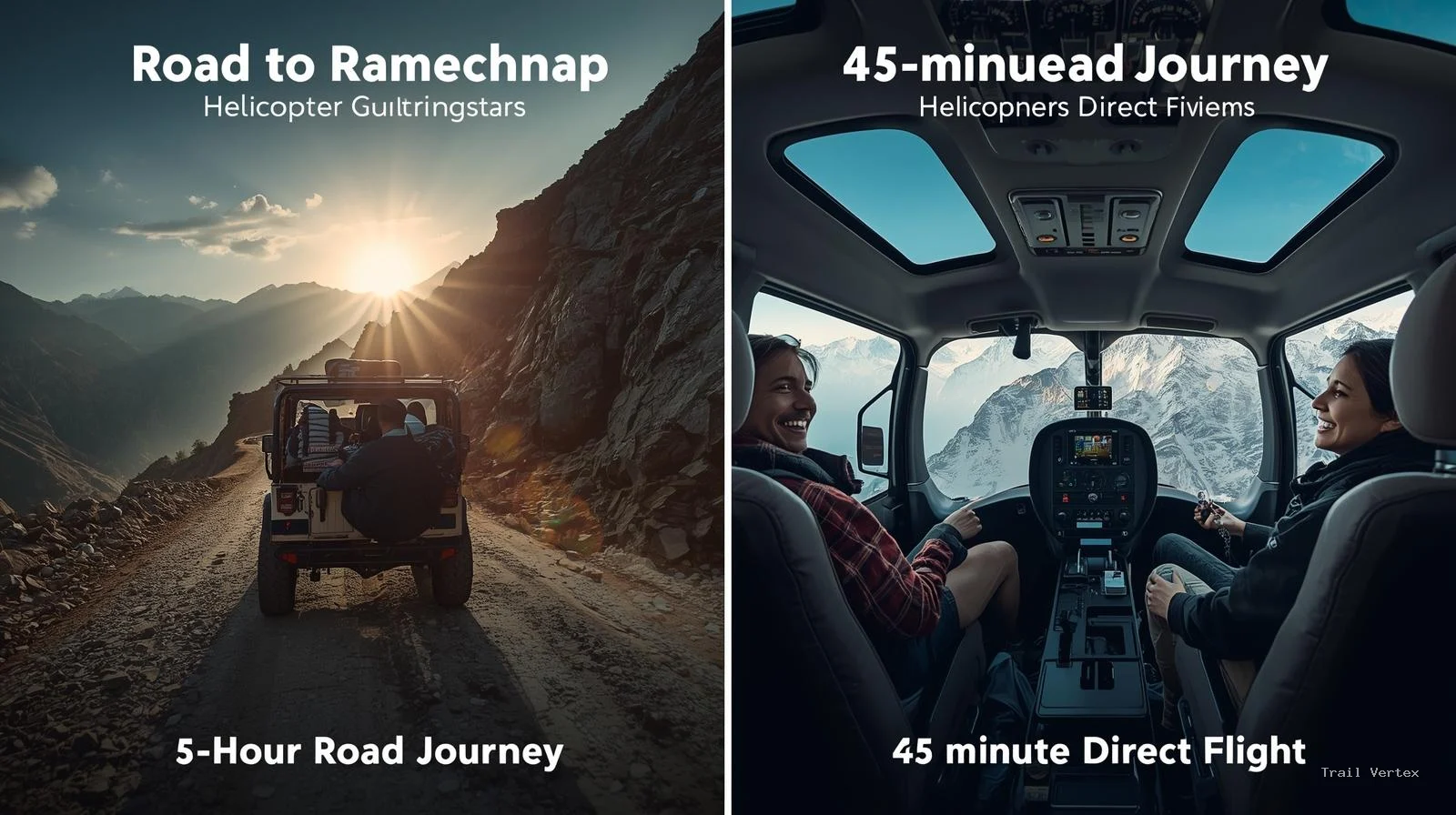
But here’s the thing about trekking to Everest Base Camp now: getting there has gotten a bit… complicated. To catch the regular flight to Lukla, you’ll actually need to see a different ride first, a long, pre-dawn jeep journey from Kathmandu to a small airport in Ramechhap. We’re talking about a 4 to 5-hour drive on winding mountain roads. And that’s just one way. Add it up, and that’s a solid 10 hours of your Nepal adventure spent in a vehicle before you’ve even taken a single step on the trail.
It’s not exactly the inspiring start you pictured, is it?
What if it didn’t have to be that way?
Imagine this instead: after a quick pickup from your hotel in Kathmandu, you’re whisked to the airport. Within the hour, you’re lifting off, not in a cramped jeep, but in a helicopter, rising above the morning haze. The city falls away, and suddenly, the Himalayas fill your window. No bumpy roads. No extra hotel night. Just you, the thrum of the rotor, and a breathtaking, 45-minute aerial journey that deposits you right onto the iconic runway at Lukla.
That’s not just a transfer. That’s the first chapter of your adventure, powerful, direct, and unforgettable. You land not exhausted, but energized. The road is behind you. The trail is right in front of you. Let’s start walking.
The "Why": It's More Than a Luxury, It's a Smart Plan
Here’s the straight truth: You can’t just fly from Kathmandu to Lukla on a regular airline ticket anymore.
That option, for most trekkers, is gone. To board one of those small twin-engine planes, you now have to make the long, tiring drive to Ramechhap Airport first. It’s just the way it is.
So, our helicopter service isn’t just a fancy upgrade. It’s the only way left to fly directly from Kathmandu to Lukla.
But that fact leads to an even bigger advantage. Think of this helicopter as your built-in insurance policy. The weather in the mountains is fickle. When cloud cover rolls in and cancels those fixed-wing flights out of Ramechhap, which it often does, often hundreds of trekkers get stuck. The backlog for plane seats can pile up for days, unraveling carefully made plans.
A helicopter changes the game. It doesn’t need the same clear runway or long visibility. It can navigate valleys and lift above cloud layers in ways a plane simply can’t. So, while others are stuck waiting and hoping, you have a direct ticket out.
Choosing this ride isn't just choosing comfort. It’s choosing certainty. It’s the smart move that protects your entire trek itinerary from day one, turning a notorious travel headache into a seamless, spectacular beginning.
What You'll See: A Himalayan Preview
You’re not just crossing a distance on this flight; you’re getting the grand, aerial preview of the journey to come.
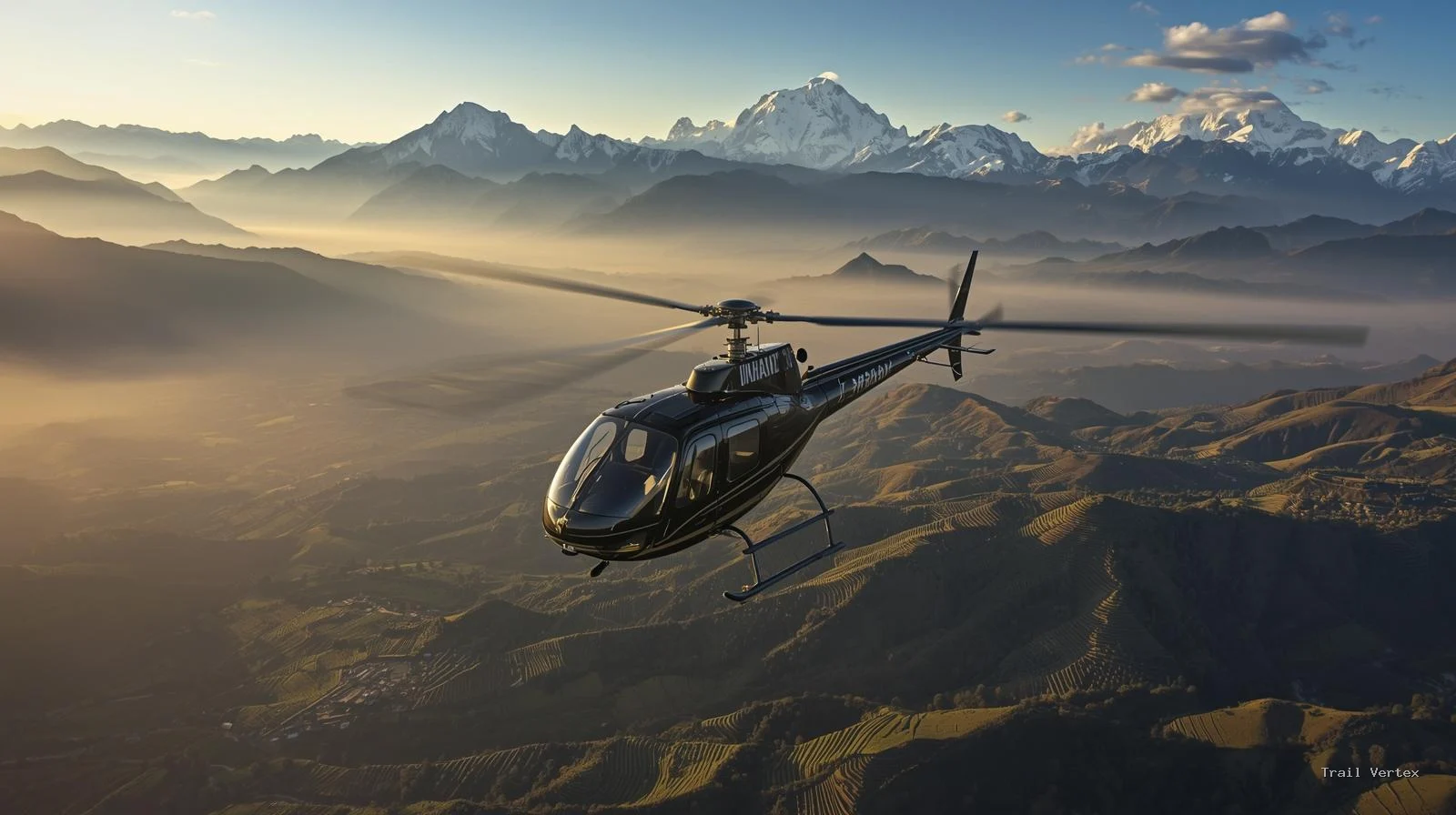
Think of it as your personal, moving IMAX theater. One moment you’re lifting off above Kathmandu’s sprawl, looking down on a quilt of terraced farms stitched into the hills. Then, almost seamlessly, the landscape deepens. Those green patchworks drop away into dramatic river gorges and sharp, shadowy foothills that seem to fold and ripple below you.
And then, you see it, the snow line. That first, brilliant flash of white on the horizon. This is where it becomes real. You’ll find yourself pointing at peaks you’ve only seen in photos. There’s the unmistakable, jagged spear of Ama Dablam, standing guard. The broad, imposing shoulder of Thamserku comes into view. You’re meeting these giants on their own terms, long before you’ll stand in their shadow on the trail.
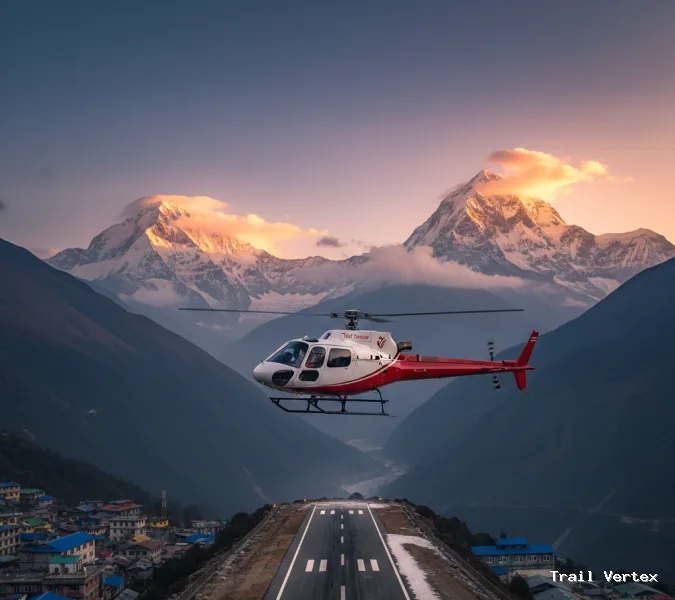
Then, the finale. The pilot banks, and the iconic short runway of Lukla comes into sight, carved right into the mountainside. The famous uphill slope fills the windshield, and you get that heart-lifting, pure-adrenaline moment of a perfect STOL landing. It’s not just an arrival, it’s your first authentic taste of Himalayan adventure.
You don’t just land in Lukla. You arrive with a story.
Your Seamless Journey: Start to Finish
Kathmandu to Lukla:
- Start: Early morning pickup from your Kathmandu hotel.
- Transfer: Direct to the domestic terminal of TIA.
- Briefing & Boarding: A quick check-in and safety briefing before you board.
- The Flight: 45 minutes of breathtaking scenery.
- End: Touch down at Lukla. Your trekking guide will be waiting, or you can walk directly to your lodge.
(The process is simply reversed for the return from Lukla to Kathmandu).
When to Choose a Helicopter (It's Clearer Than You Think)
- When Flights are Grounded: If planes haven't flown for a day or two, book a helicopter. It’s the fastest way to jump the queue.
- On a Tight Schedule: If you have a tight international connection flying home and cannot risk the 5-hour drive back from Ramechhap to catch it.
- For Pure Comfort: To avoid the physically taxing road journey to Ramechhap, especially after a long trek.
The Essential Details: Helicopter vs. Airplane
FeatureDomestic AirplaneHelicopter (Shared). Departure PointRamechhap (4-5hr drive from KTM)Kathmandu (Direct)Cost (One-Way)$180 - $220$450 - $600ViewStandard Side WindowPanoramic / 180-DegreeReliabilityLow (Highly weather-dependent)High (More flexible)Travel Time (Door-to-Door)8-9 HoursUnder 2 Hours
Weight Limit: The standard allowance is 10 kg of checked duffel + 5 kg hand carry per person. Excess weight is charged at $1-$2/kg, subject to payload limits.
Sample Morning Schedule:
- 06:00 AM: Pickup from your Kathmandu hotel.
- 06:30 AM: Check-in and security at TIA domestic terminal.
- 07:15 AM: Takeoff from Kathmandu.
- 08:00 AM: Land at Lukla Airport, ready to trek.
Must-Know Travel Information
- Permits: No special "heli permit" is needed. You will obtain the Khumbu Pasang Lhamu Rural Municipality Permit and the Sagarmatha National Park Entry Permit in Lukla or Monjo.
- Best Time to Fly: Pre-monsoon (March-May) and Post-monsoon (September-November). Always aim for the earliest flight of the day (6:30-9:00 AM) for the calmest, clearest conditions.
- Travel Insurance: This is non-negotiable. Your policy must explicitly cover helicopter evacuation and trekking up to 5,500 meters.
- Altitude Note: Lukla is at 2,860m. While you fly there quickly, take it easy on your first day. Walk slowly, drink plenty of water, and let your body adjust.
- Respect the Culture: As you enter Lukla, you'll see carved Mani stones and prayer flags. Always show respect by walking clockwise around these and any other religious structures like chortens or stupas.
Conclusion & Your Next Step
The Kathmandu to Lukla helicopter ride has evolved from a luxury into a strategic travel decision. It protects your itinerary, saves your energy, and starts your Everest adventure with a profound sense of awe.
If your dream trek has a fixed schedule, or you simply want to invest in a seamless, spectacular beginning, this is your best option.
Ready to secure your direct flight to the Himalayas?
[Contact us now to check availability and book your seats.]
FAQs (Questions Real Travelers Ask)
Q: How much does a shared helicopter from Kathmandu to Lukla actually cost?
A: For a one-way shared seat, prices typically range from $450 to $600 per person, depending on the season, group size, and operator. It's a significant investment that pays off in saved time and reliability.
Q: Can helicopters fly to Lukla when airplanes are cancelled?
A: Very often, yes. Helicopters require less visibility and no runway length to operate, giving them a wider weather window. They are the preferred backup when fixed-wing flights are grounded.
Q: Is it safe? What kind of helicopters are used?
A: Safety is the top priority. Reputable operators use modern, powerful aircraft like the Airbus H125 (AS350 B3e), famously known as the "Eurocopter," piloted by experienced Nepali aviators who specialize in high-altitude mountain flying.
Q: Can I book the entire helicopter for my group?
A: Absolutely. Private charter is a fantastic option for families or small groups. It offers maximum schedule flexibility and can sometimes be more cost-effective than multiple individual airline tickets with the added road transport.
Q: What if the weather is bad in Lukla on my flight day?
A: Your safety is paramount. If conditions are unsafe in Lukla, your flight will be delayed or rerouted (e.g., to an alternate helipad). Operators work closely with you to reschedule or provide a refund as per their terms.